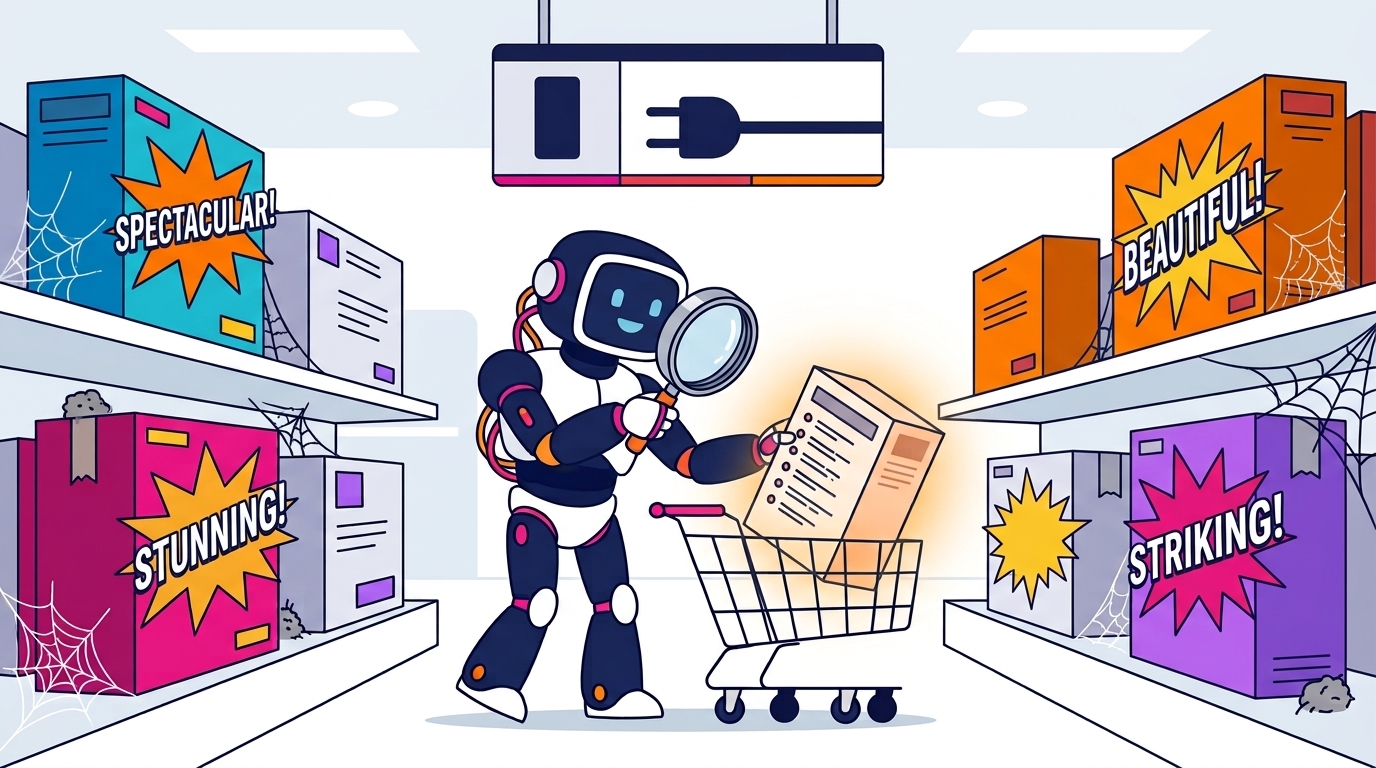
AI now makes two decisions about your brand: what it says about you, and whether it chooses your product for the job.
In April, we wrote that your buyer's next search won't be a search at all. It will be a task. Instead of typing a question into Google and clicking through ten blue links, buyers will hand a job to an AI agent and let it figure out the rest.
This fall, that idea became a product feature. On September 25, Anthropic opened a submission portal for its Claude directory, where companies can list plug-ins and connectors to their products that people can add right inside Claude. Four days later at DevDay, OpenAI changed how plug-ins are ranked and recommended inside ChatGPT's directory, and when ChatGPT suggests one amongst several options. Not to be left out, on November 17, Google starts converting Gemini Gems into Skills, which Gemini can apply on its own when it decides a particular Skill is relevant.
When you combine these announcements, a pattern shows up. AI agents are no longer just answering questions about brands. They are choosing which brand gets selected to do the work. That gives every company two jobs: get cited and get picked.
Why doesn't Google quote your own website?
Start with the first job. When someone searches your company’s name, the first thing they see isn’t your website. It's Google's AI describing your company.
Ahrefs analyzed 232.8 million US Google searches and found that on September 29, 2026, AI Overviews appeared on 82.91% of branded searches. The monthly average climbed from 61% in July to 73% in September. In Ahrefs' study last November, it was just 13%.
Ahrefs also searched the names of 100 of the world's best-known brands. When Google showed an AI Overview, it sat at the very top of the page, above the link to the brand's own website, about three out of four times. And when Google's AI describes a brand, it often quotes other websites. Wikipedia was a source in 72% of those AI Overviews, with YouTube and LinkedIn next.
There are good reasons why this happens. A company's own site is self-promotional, so AI gives more weight to sources with no stake in the answer, the same way a reporter would. AI also favors facts it can confirm across several places. And Wikipedia is written as plain facts, while many company sites are written as marketing copy that's hard to quote as a fact.
How do I get Google’s AI Overviews to describe my company correctly? The good news is that most of this is fixable. Here's where to start.
- Put plain facts on your company’s website. Your About page and FAQ should state the basics in simple sentences that an AI agent can lift directly: what you do, who it's for, when you were founded and how you charge. If a sentence wouldn't work as a quote, rewrite it.
- Fix the sources Google trusts. Check your Wikipedia and Wikidata entries for accuracy. Update your LinkedIn company page and your executives' profiles so they match what you say today, not two years ago.
- Earn third-party coverage. Media coverage, customer reviews and analyst mentions are the independent sources that AI engines prefer over a company’s website. In the AI era, this is the strongest argument for PR.
- Own your video presence. YouTube is the second most cited source in Ahrefs' data. Publish current explainer and demo videos, and update or retire old ones that describe products you no longer sell or that communicate old positioning and messaging.
- Keep your facts consistent everywhere. Use the same description, numbers and positioning on every profile. When AI engines see one story repeated across many sources, they trust that story.
How does ChatGPT decide which plug-in or connector to pick?
The second job is newer and much less is known about it. OpenAI hasn't published how it ranks plug-ins. So a few days after DevDay, we ran a quick experiment.
We gave ChatGPT a real task: turn a newsletter essay into a six-slide LinkedIn carousel in our brand colors. We asked which plug-ins it would consider, which it would pick and why, and what in each plug-in's description or reputation influenced the choice. Then we ran the same task twice more, adding one constraint each time.
With no constraint, ChatGPT picked Canva, with Gamma as the runner-up and Figma third. Its reason was specific. Canva's plug-in listing names Brand Kit checks for colors, fonts and logos, layout and readability feedback, and LinkedIn resizing. ChatGPT said those "specific promises" carried more weight than "general claims about 'beautiful slides.'"
When we added "I'm on a tight budget," the answer changed completely. Canva dropped out of first place because its own listing says design generation uses Canva AI credits. ChatGPT passed over every plug-in and instead chose its own built-in presentation tools. It dismissed one option, Genspark AI Slides, because its description was "too general" to show brand-color control or a no-cost workflow. Its summary was blunt: "'Beautiful' and 'professional' are marketing claims; explicit capabilities and credit requirements are more useful."
When we said the carousel had to be polished enough for a Fortune 500 client, Canva won again and Figma moved up to second. ChatGPT explained why it didn't simply switch to the tool with the stronger design reputation: "a product's design reputation doesn't establish that its plug-in will deliver a better carousel."
This was a quick test, not a study, and ChatGPT itself noted it hadn't compared the plug-ins head-to-head. But the pattern held across all three runs. The AI agent chose based on what each listing specifically promised, and it skipped plug-ins with vague descriptions.
Scott Stouffer, founder and CTO of Market Brew, offered a useful explanation in the discussion of our results. AI systems can find plug-ins that sound close to the buyer's task, he noted, but if every description sounds alike, the model has little reason to choose one over another. What gives it a reason is new information the alternatives don't supply: specific capabilities, constraints and evidence.
In other words, the same rule applies to both jobs. Vague descriptions get skipped. Specific descriptions get selected and used.
AI is choosing more than tools
Plug-in directories are just the most visible example. Across the industry, more of what AI does is choosing, not writing.
Take Jev, a new model from TypeSafe AI that launched in September. Jev doesn't write answers at all. You give it a situation and a list of options, and it picks one, with a confidence score, in a fraction of a second. Workday now uses it to decide which pieces of its interface to show each user as they type. As a Forbes article on Jev put it, most of what an AI agent asks a model to do is not writing; it’s choosing.
Every one of those choices is a moment where your brand is either on the list or not, and either described clearly enough to win or not.
What to do this quarter
If you sell software or a service that does a specific job, like design, payroll, analytics or testing, here’s a checklist for both halves: getting an AI engine to describe your company accurately, and getting AI agents to choose your product.
To get an AI engine to describe your company accurately (how does my company get cited):
- Search your own company name in Google and read the AI Overview. Note which sources it quotes.
- Fix anything inaccurate on Wikipedia, Wikidata, LinkedIn and YouTube.
- Rewrite your About page and FAQ in plain, quotable facts.
- Plan for third-party coverage, not just owned content.
To get picked when an AI agent searches plug-in, connector and skill directories:
- Decide whether your product belongs in the ChatGPT or Claude directories, or as a Gemini Skill.
- If you decide to list your product or service, make sure that the description says exactly what it does, who it's for and when to use it.
- Name your concrete features and be upfront about costs and limits. The AI agent reads and relies on those details.
- Test it. Ask ChatGPT to do a task that your product solves, then add a constraint like budget, speed or a high-stakes client, and see who gets picked and why.
Get found. Get cited. Get chosen.
For two years, AI visibility meant one thing: does the AI engine mention your company? That still matters, and the Ahrefs data shows the stakes are rising fast. But AI agents are now doing more than talking about brands. They’re choosing which ones to use and telling users.
Being cited gets you mentioned. Being picked gets you used. The companies that win the next few years will work on both.
Sources: Ahrefs, “AI Overviews Currently Appear for 83% of Branded Searches,” Ryan Law, October 2, 2026. Anthropic Claude directory submission portal, September 25, 2026. OpenAI DevDay, September 29, 2026. Google Gemini Gems-to-Skills transition. The New Stack, “Workday is using TypeSafe’s Jev to build user interfaces on the fly,” Frederic Lardinois, October 13, 2026. Forbes coverage of TypeSafe’s Jev, September 2026. Ignite X ChatGPT plug-in test, October 1, 2026.