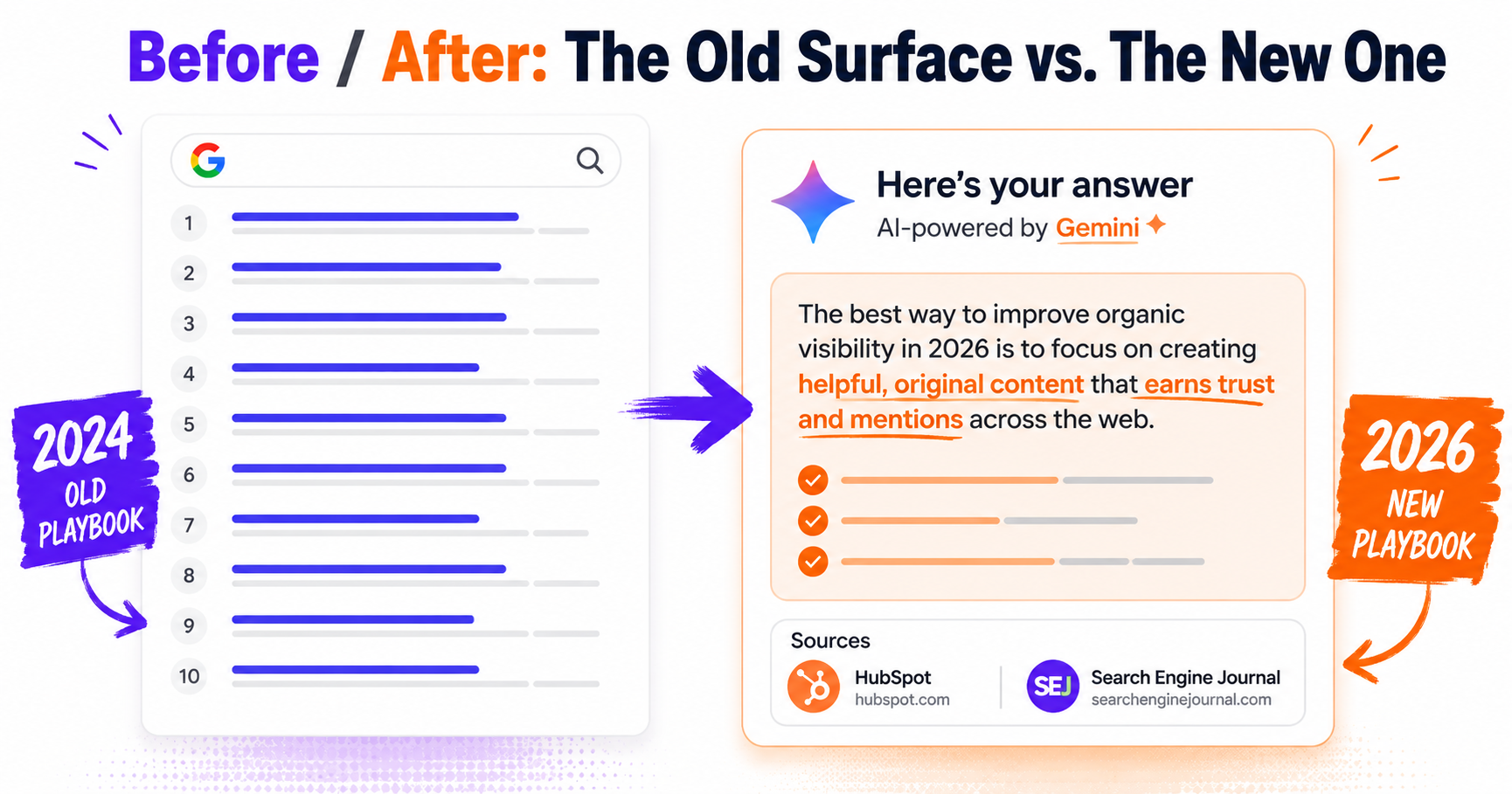
When we saw the article, we jumped over to Google and ran a random search. The result looked foreign. The traditional search results page has been replaced with an intelligent search box centered on AI agents that answer queries, run background information agents, and execute tasks on behalf of the user. AI Overviews are already serving 2.5 billion monthly users, and Conversational AI Mode has crossed 1 billion monthly users. Generative UI now builds custom interactive results on the fly via Google Gemini and Antigravity.
For brands, the announcement is not a feature update. It is a tectonic category shift. The discovery surface your buyer uses to find, compare, and decide whether to trust you got a full renovation from the ground up. The playbook every marketing team, growth expert, comms department, and PR team has been refining for the last two decades was tuned for a discovery geometry that no longer exists.
The question every operator should be asking this week is the same as the title of this piece. When Google rebuilds the search box, what survives of the playbook built on it? And, what gets replaced?
What Actually Changed at I/O
The substantive shift of Google's new search box is the interface itself. For 25 years, the search results page was a list of blue links that a buyer scanned and could choose from. The brand that ranked first won the click. The brand that ranked tenth got a fraction of buyer traffic. SEO was the discipline of climbing that list. PR was the discipline of getting earned coverage that helped the climb. Content strategy was built around the moment a buyer scanned the list and decided which blue link and title to click.
The new search surface doesn't present a list at all. It presents an answer. The AI agent reads the buyer's query, queries a synthesis of authoritative sources, and presents a response. Sometimes that response cites specific brands. Often it doesn't. The buyer reads the response, asks a follow-up question, and never sees the underlying list of links or other content that the engine presented.
Consumer reaction to this change has already shown up in new data. DuckDuckGo reported that U.S. app installs grew 18.1% week-over-week on average between May 20 and May 25, peaked at 30.5% on May 25, and reached 33% week-over-week growth on iOS downloads with a single-day peak near 70%. Visits to its AI-free search page, noai.duckduckgo.com, grew 22.7% on average with a 27.7% peak. The defection is small in absolute share, but the direction is unmistakable. A consumer counter-movement is building around the choice to opt out of AI-mediated search.
Less covered but equally important: on May 15, Google updated its Search spam policies to explicitly include manipulation of AI Overviews and AI Mode. Craig Newmark amplified the change on LinkedIn, calling it "a big deal." Google didn't just rebuild the surface; it also set enforcement rules for how brands can appear in it. The brands optimizing for citations within an AI response are now operating under a published policy framework. And brands trying to game Google's AI Overviews are now operating in violation of a published policy.
Why the Old Playbook Breaks
The old PR playbook was built on three working assumptions. First, that visibility meant ranking inside a list. Second, the buyer would scan the list and click. Third, that the click was the endpoint or the moment the buyer reached your brand. Each of those three assumptions is now wrong or weakening.
Ranking inside a list doesn't describe the new discovery surface. There is no list. There's an answer, and the question is whether the AI model decides to mention your brand inside it. Inclusion is a different discipline from ranking. Ranking is about which side of a fixed slot order your brand sits on. Inclusion is about whether the AI model decides to name you at all. The signals that drove ranking, including domain authority, keyword density, and backlink graph weight, contribute to inclusion, but they're no longer sufficient. The AI model also weighs source diversity, recency, citation consistency across surfaces, and whether your brand cleanly maps to the buyer's expressed intent.
Scanning and clicking don't describe the new buyer behavior. The buyer reads the AI answer. If the answer is sufficient, the click never happens. Zero-click queries now account for the majority of search traffic, and the new surface further accelerates that. The brand that wins the answer wins the buyer. The brand that wins the click after the answer wins a follow-up. The brand that doesn't appear in the answer never enters the consideration set.
The click is no longer a reliable point of arrival. The buyer of 2026 is increasingly traveling with an AI agent. That agent reads the answer, evaluates the brands cited against the buyer's preferences, and makes a recommendation. The arrival point is the recommendation; it's no longer the website. The brand that the agent recommends gets a buyer. The brand the agent skips over doesn't.
Each of these three shifts is small on its own. Collectively, they describe a discovery geometry that is fundamentally different from the one the old search playbook was tuned for.
What the New Playbook Requires
The new playbook for AI-era PR organizes around three disciplines. None of them is new in isolation. What is new is how they must be sequenced and integrated to drive a citation within an AI answer.
Discipline 1: Earned coverage that AI engines weight as authoritative. The single largest determinant of whether an AI engine cites your brand is whether independent, credible third-party sources have published about your brand recently. Self-published content (your website, your blog, your company LinkedIn) is heavily downweighted in the citation algorithms. Earned media coverage (journalist coverage, contributed articles in tier-one publications, analyst commentary, podcast interviews, conference talks reported on) is heavily upweighted. PR is no longer a brand-awareness function. PR serves as the input layer for AI engine training and retrieval.
Discipline 2: Community presence on surfaces AI engines source from. Reddit, Stack Exchange, G2, industry forums, and category-specific communities are now part of the citation graph. The brands that have founders or subject-matter experts answering questions consistently on those platforms build a citation footprint that compounds. The brands that ignore community presence end up invisible to the AI engines that source from it. This is not social media in the influencer sense. This is operational visibility on the surfaces that AI models read.
Discipline 3: Owned content engineered for AI engine readability. Your website, your knowledge base, your FAQ pages, your glossaries, your comparison tables, and your pricing pages are all surfaces that AI engines can crawl. The brands that win citations have owned content with clear schema markup, structured data, consistent messaging and positioning language across the web pages, and direct answers to the questions that buyers ask. The brands that have a beautifully designed homepage but no answer pages aren't legible to the AI engines doing the citing.
We've called this the Three-Layer Citation Stack in previous work. The framework still holds. What changes after I/O is the immediacy. The brands that built citation infrastructure over the past 12 months are now sitting inside a discovery surface that prizes exactly that infrastructure. The brands that sit on the sidelines are about to discover that their playbook expired in May 2026.
The Spam Policy Update Matters More Than It Looks
Google's May 15 policy change is the most under-reported part of the I/O cycle, and it's the most consequential one for PR leaders. Two implications are worth holding together.
First, Google's policy update validates that AI search visibility is a real, governed surface. Categories with a published rulebook have professional disciplines around them. PR has had one for a century. SEO has had one for two decades. AI Search Visibility now has one. Disciplines with rulebooks are budgeted and staffed. Disciplines without one get dabbled in.
Second, the policy draws a clean line between legitimate Machine Relations work and spam tactics. Legitimate work earns credible third-party coverage, builds community presence, and structures owned content for clarity. Spam tactics try to game Google's model through keyword stuffing, fake reviews, content farms or content volume, and manipulated citation graphs. Brands relying on the second set are now operating in violation of a published policy. Brands building the first set are now operating within the rule book.
The question every comms leader should be asking their agency this quarter is clear. Which side of that line are we on, and what's the evidence?
What to Do This Week
The shift Google announced at its annual I/O conference doesn't require a six-month strategic review. It requires three operating actions this week.
- Audit your AI citation baseline. Pick the four AI engines your buyers use most often: typically ChatGPT, Claude, Perplexity, and Google Gemini. Run the queries your buyers run. Note whether your brand appears in the answers. Note which competitors appear in the answers you don't. That's your baseline.
- Map your earned media calendar to the next 90 days. If you don't have two to three tier-one earned media pieces or relevant, influential niche publications in flight or recently published, you have a citation drought ahead. The model favors recency. A brand that earned coverage in February but has been silent since is fading from the citation graph by July.
- Pressure-test your owned content for AI engine readability. Pull up your three most strategically important pages. Read them as the AI model would. Are the answers structured, scannable, and direct? Is the schema markup present? Does the positioning language match across pages? Is the brand mapped to specific problems and outcomes or to generic category language?
Those three actions take a week of focused work. The output is a citation strategy that matches the surface Google rebuilt, rather than the one Google retired.
The Quiet Confidence Underneath the Reset
Two final framings worth holding onto.
The first is that the disciplines underneath AI-era PR are not new at all. Earned credibility, community presence, expertise that's published in retrievable form, and consistent messaging have always been the foundation of brand authority. What Google I/O changed is the discovery surface that rewards them. The brands that have done this work for years are now sitting in a tailwind they didn't anticipate, but are perfectly positioned to ride it.
The second is that the brands that built playbooks tuned exclusively for the ten blue links are now in the position SEO consultants were in when Google rolled out the BERT update, or content farms were in when Google rolled out Panda. The platform changes. The discipline that fits the new platform compounds. The discipline that fits the old platform fades.
Google rebuilt the search box. And the playbook built on it is being rebuilt at the same time. The brands that move first inside the next two quarters will compound an advantage that latecomers cannot reach. The brands that wait are betting that the new surface will revert to the old one. It will not.