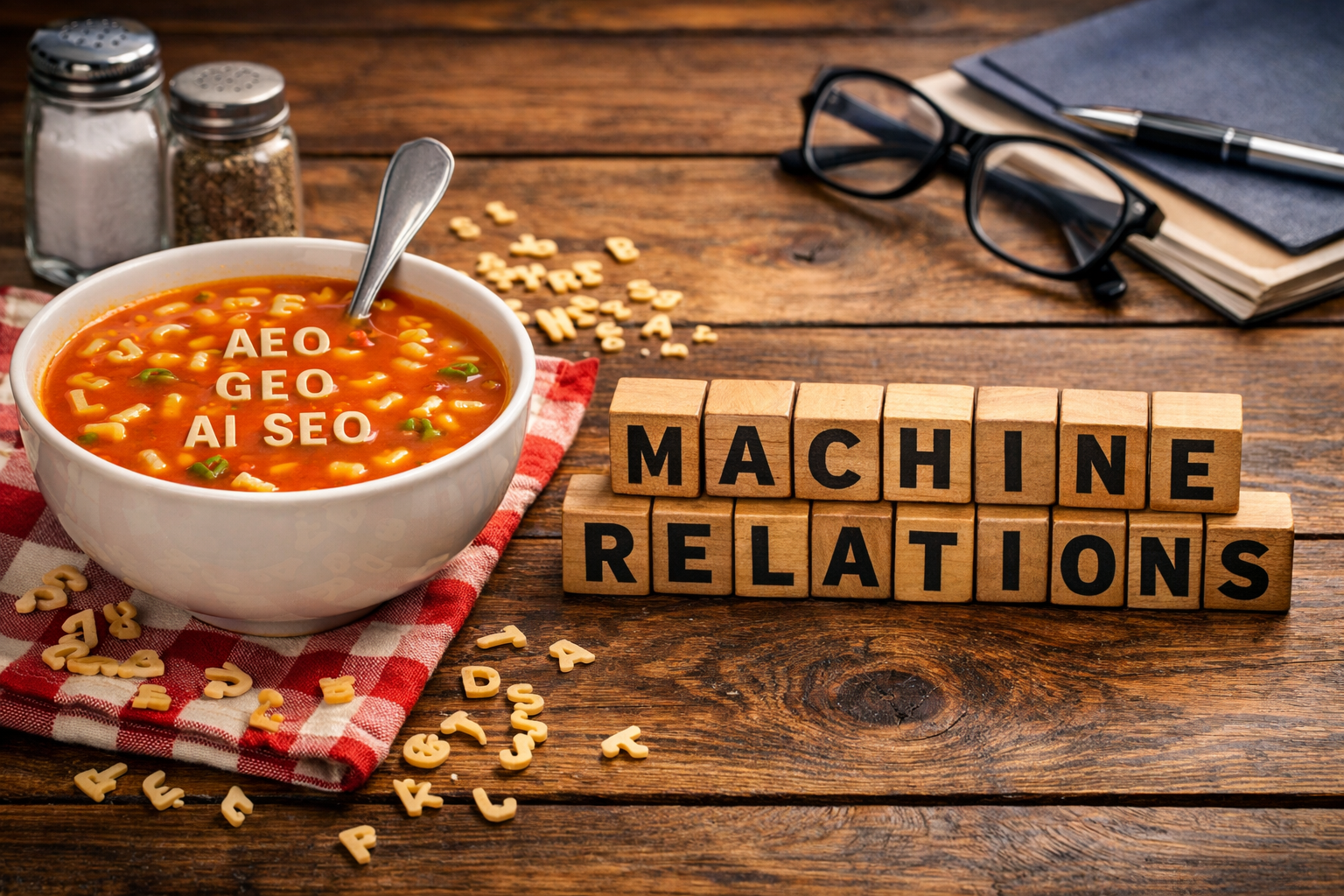
The Acronym Explosion
In the last 18 months, the marketing world has been flooded with new terms for essentially the same emerging challenge: how brands show up in AI-generated answers. AEO (Answer Engine Optimization). GEO (Generative Engine Optimization). AISEO (AI Search Engine Optimization). LLM SEO. Every agency and thought leader is coining their own version. The result? Founders and marketing leads are more confused than ever. The acronym pile is growing faster than anyone's ability to act on it. The terminology has become a barrier to progress rather than a path forward.
This confusion matters because brands need clarity to move. They need to understand what's actually changing in how AI discovers and recommends them. They need a framework that captures the full picture. And they need language that doesn't require a glossary.
What Everyone's Actually Talking About
Strip away the jargon and name the shift plainly. Traditional search sent users to websites. AI search gives users answers directly, citing sources inline. When someone asks ChatGPT, Perplexity, or Gemini about a product category, the brands that get mentioned win consideration. The brands that don't, don't exist in that moment. This is the shift that AEO, GEO, and AISEO are all trying to describe. They're pointing at the same elephant from different angles.
The core dynamic is unchanged: visibility equals discoverability equals consideration. What has changed is the visibility mechanism. Your Google ranking doesn't matter if AI never mentions your company. Your SEO efforts are invisible if you don't appear in the answer. This is why every agency is scrambling to coin a term and claim expertise in this new frontier.
But the acronyms obscure more than they clarify. They make the challenge sound technical when it's actually strategic. They make it sound like an optimization problem when it's actually a communications problem.
Why the Acronyms Fall Short
The problem with AEO, GEO, and AISEO is that they frame this as an SEO problem. They assume the playbook is the same: optimize content, tweak metadata, rank higher. But AI engines don't rank pages. They synthesize answers from hundreds of sources and decide which brands deserve mention. This is a fundamentally different challenge that requires a fundamentally different approach.
It's not about optimizing for an algorithm. It's about building the kind of cross-platform authority and information architecture that makes AI engines confident enough to recommend you. The signal that matters isn't page ranking. It's consistent citation across authoritative sources. It's third-party validation. It's narrative coherence across multiple publications.
These are not SEO strategies. These are communications strategies. AEO, GEO, and AISEO all imply that if you just tweak your content and metadata, the engines will reward you. This is partly true, but it misses the bigger picture. AI engines are trained on earned media. They trust sources that independent editors have validated. They look for signals of authority, not just keyword matches.
Machine Relations: A Framework, Not an Acronym
Machine Relations treats AI visibility as a communications discipline, not a technical SEO task. The name is intentional: just as media relations describes how organizations build relationships with journalists and publications, Machine Relations describes how organizations build trust and authority with AI systems. This isn't wordplay. The distinction matters.
Media relations works because companies invest in consistent messaging, credible third-party validation, and strategic narrative placement over time. Machine Relations follows the same principles, applied to a new audience. The work involves:
- Ensuring consistent entity information across authoritative sources
- Earning citations in the publications and platforms that AI engines trust most
- Structuring content so AI systems can confidently extract and attribute claims
- Monitoring how AI platforms describe your brand across ChatGPT, Perplexity, Gemini, Claude, and others
This is familiar work, executed in service of a new audience. The ROI is measurable. According to recent research, the revenue difference between the #1 cited brand and the #4 brand in an AI response is staggering. Position 1 captures the full value; position 4 captures roughly 1%. The window for establishing authority in AI answers is open right now, and it won't stay open forever.
The First-Mover Window
Most brands are frozen. The confusion and competing acronyms have created hesitation where there should be action. The brands moving now, quietly and strategically, are building the kind of citation authority that will be extremely difficult to displace once established. AI engines develop persistent associations. The first brand to consistently appear as the trusted answer in a category tends to hold that position.
This is not unlike how early movers in traditional SEO dominated page-one rankings for years. Except in AI search, there's no page two. You're either mentioned or you're invisible. The stakes are higher, and the window narrower.
Consider what happens when an investor, a potential customer, or a journalist queries ChatGPT about your market. What does it say? Does it mention you? If so, what claim does it make? If not, your entire category positioning has been defined without your input. The cost of waiting is the permanent loss of positioning in a new discovery channel.
Start With Clarity
The terminology will keep evolving. New acronyms will appear next quarter. What won't change is the underlying reality: AI systems are now a primary discovery channel, and the brands that invest in Machine Relations today will own the conversation tomorrow.
For organizations ready to move past the alphabet soup, the path forward starts with understanding where your brand stands in AI-generated answers today, and building a deliberate strategy to improve that position. This isn't speculation. This is measurable. This is actionable. And the first-mover advantage is real.
The acronym pile will keep growing. But the solution is singular. Machine Relations. It's a name that captures both the challenge and the playbook, and it's the framework that works.