9.5M citations later and thought leadership content came in last.
If you scrolled LinkedIn this week, you likely saw its promoted posts: "Top 5 takeaways for creating citable content." So now we have LinkedIn running paid ads to teach marketers how to earn citations from AI engines. The citation economy officially has an ad budget.
The ads point to real research. Meltwater (a PR software company) and LinkedIn analyzed 9.5 million AI citations across six models (ChatGPT-5, Copilot, Gemini 2.5 Pro, Claude Sonnet 4, and Google's two AI search products), all focused on B2B queries. A quick disclosure about this research before we go further: this report is LinkedIn co-branded research, concluding that (you guessed it) LinkedIn wins, so keep one eyebrow up and apply that Parser eye. The patterns inside still deserve your attention nevertheless.
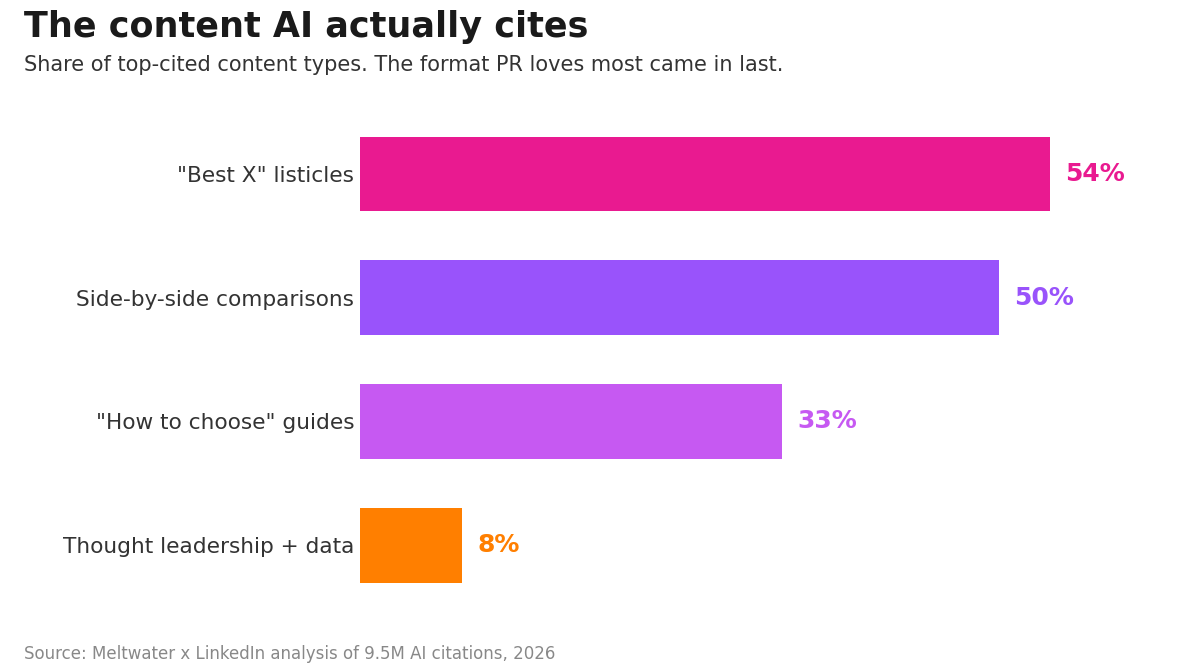
Among the most-cited content types, the report found the following: "Best X" listicles led at 54%, side-by-side comparisons hit 50%, and "how to choose" guides came in at 33%. Thought leadership content with statistics came in dead last at 8%. The content format that the PR industry treats as its crown jewel is the one that AI engines cite least, according to this report.
The second finding should reshape a few budgets: 75% of LinkedIn citations came from individual member profiles, not LinkedIn Company Pages. Surprisingly, expertise beat audience size, too. The study's most-cited finance voices have 20K and 74K followers, not millions of followers. A founder who publishes structured, specific answers to buyer questions is now a citation asset with more pull than the corporate logo.
Here's the strategic read. Now that LinkedIn is advertising the recipe (structure, named entities, hard numbers, buyer questions), the recipe stops being an edge. Every marketer gets the same checklist this quarter. What LinkedIn can't sell you is the "whether": whether the engines actually cite you, describe you accurately, and put your name in "the answer" when a buyer asks. That part is measurement, and it's still missing from every checklist in circulation.
So the next 12 months belong to the teams who treat the checklist as the floor, not the strategy. Running LinkedIn's five steps makes your content legible to AI engines; it doesn't make you the answer. Once everyone's content is structured, sourced, and fresh, the checklist stops separating anyone. What separates brands at that point is proof: measuring what the AI engines actually say about you, knowing which buyer questions you win and lose, and closing the gaps with work no checklist mentions. That's the work.
Get Found. Get Cited. Get Chosen.