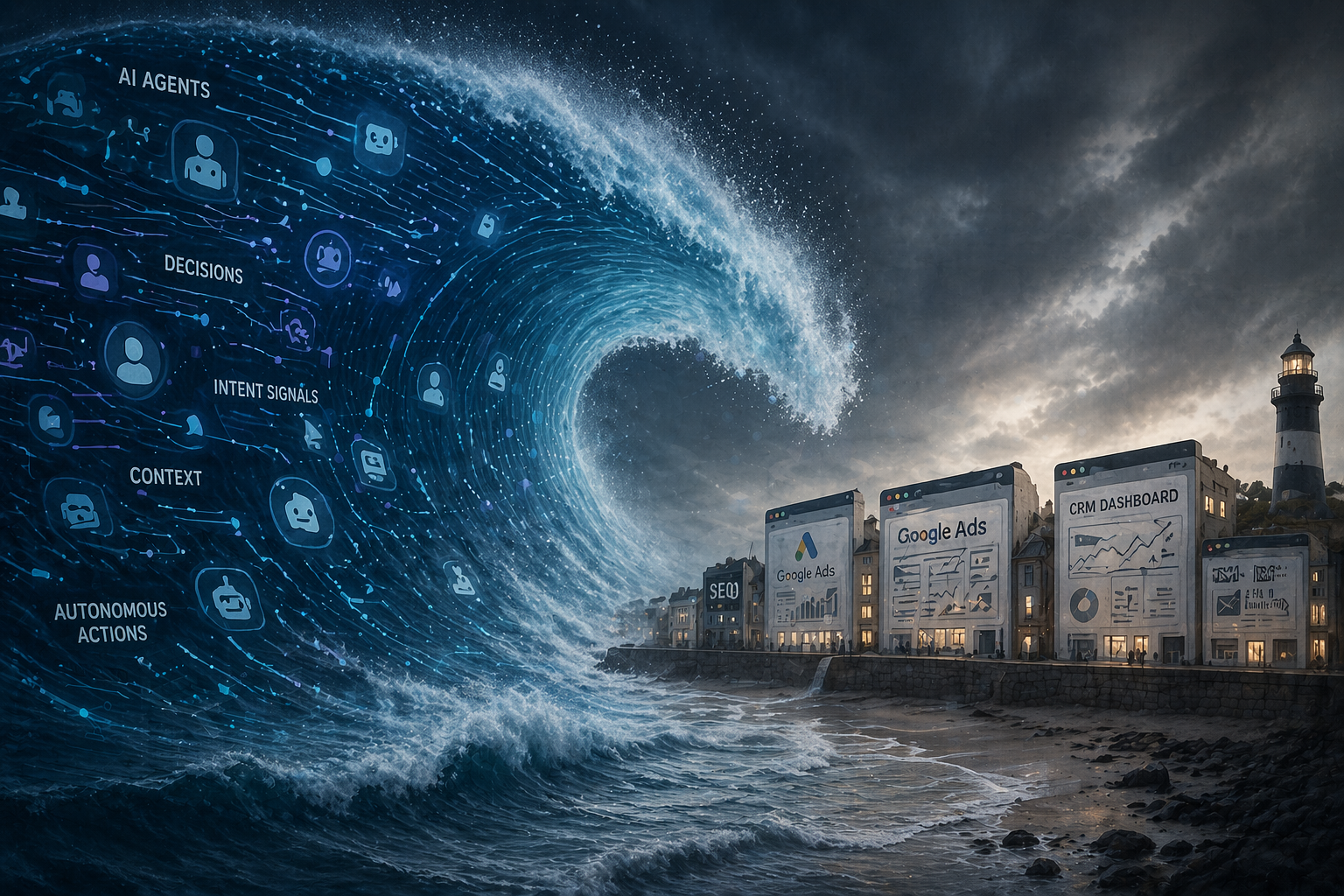
The web has three layers now. Most companies can only see one.
Here's the simplest way I can frame what's happening.
The web is reorganizing itself into three layers. Most brands are still stuck on the first one. The companies that see all three will have a massive head start. The ones that don't will spend the next two years wondering why their pipeline dried up. This is no joke.
Layer 1: AI Search Citations.
This is where most of us are waking up, wondering why those Google ads and leads and SEO aren't converting, wondering why all of it flatlined. ChatGPT, Perplexity, Gemini, and Claude are already the front door for a growing number of buyers. 50% of B2B buyers now start their research on ChatGPT. 54% use it to build their vendor shortlist. And 9 out of 10 (yes, 90%) pick the first recommendation that the AI platform presents. If your brand isn't showing up in those answers, you're not in the consideration set. Period. This layer is real, it's measurable, and most companies are still not doing anything about it.
Layer 2: AI Agent-Assisted Buying.
This is arriving faster than anyone expected. AI agents aren't just answering questions anymore. They're evaluating products, comparing options, and influencing purchase decisions on behalf of the human sitting behind them. Stripe reported that 20% of its funnel now involves agentic traffic. G2 saw 1,000,000,000 visitors from AI search in 2025. The buyers are still human, but the research, shortlisting, and recommendation work is increasingly delegated to AI.
Layer 3: Autonomous Agent Transactions.
This is where it gets wild. Here's what I'm red-flagging as a tsunami warning. Visa just unveiled Intelligent Commerce Connect, a platform that lets AI agents make payments across multiple card networks. No traditional checkout flow required. Merchants can make product catalogs directly discoverable to AI agents. When the largest payment processor on the planet builds checkout for AI machines, the question isn't whether agents will transact. It's which brands they'll choose.
And then, last week, Salesforce dropped Headless 360. The entire Salesforce platform, from CRM to Agentforce to Slack, is now exposed as APIs, MCP endpoints, and CLI commands. Their CTO called it "the most ambitious architectural transformation in Salesforce's 27-year history." The message was blunt: the browser is optional. The API is the UI. SaaStr, an annual Software-as-a-Service Conference, revealed they're already spending 15x more on agent infrastructure than on their own Salesforce CRM licenses. Their team built an 'AI VP of Marketing,' comprised of 14,230 lines of code, as well as AI VP of Customer Success, and an AI sales agent. The AI Sales agent closed $3M+ in revenue in less than a year. Collectively, the company is comprised of 3 humans, 1 dog and 20+ AI agents in production to run their business.
Pause and sit with that for a second. The entire commercial web, from discovery to evaluation to purchase, is being rebuilt around a new class of users that don't click, don't scroll, and don't respond to your marketing copy. This new class of users are AI agents and they will outnumber the number of humans using the web in a huge factor.
This isn't a prediction. The infrastructure is live. The payment rails already exist. Salesforce just chopped off its own CRM UI to offer it headless. The only question left is whether your brand is ready for a world where the thing evaluating you isn't a person with a browser. It's an AI agent with a task.
We've been building toward something at Ignite X that addresses exactly this shift. More on that soon. For now, the takeaway is simple: the brands that build the right signals across all three layers, not just Layer 1, will own the next era of discovery. If they start now, they'll reap the early mass of AI agents crawling the web on behalf of their buyers looking to transact with the right vendors and companies for the products and services needed.
Get Found. Get Cited. Get Chosen.