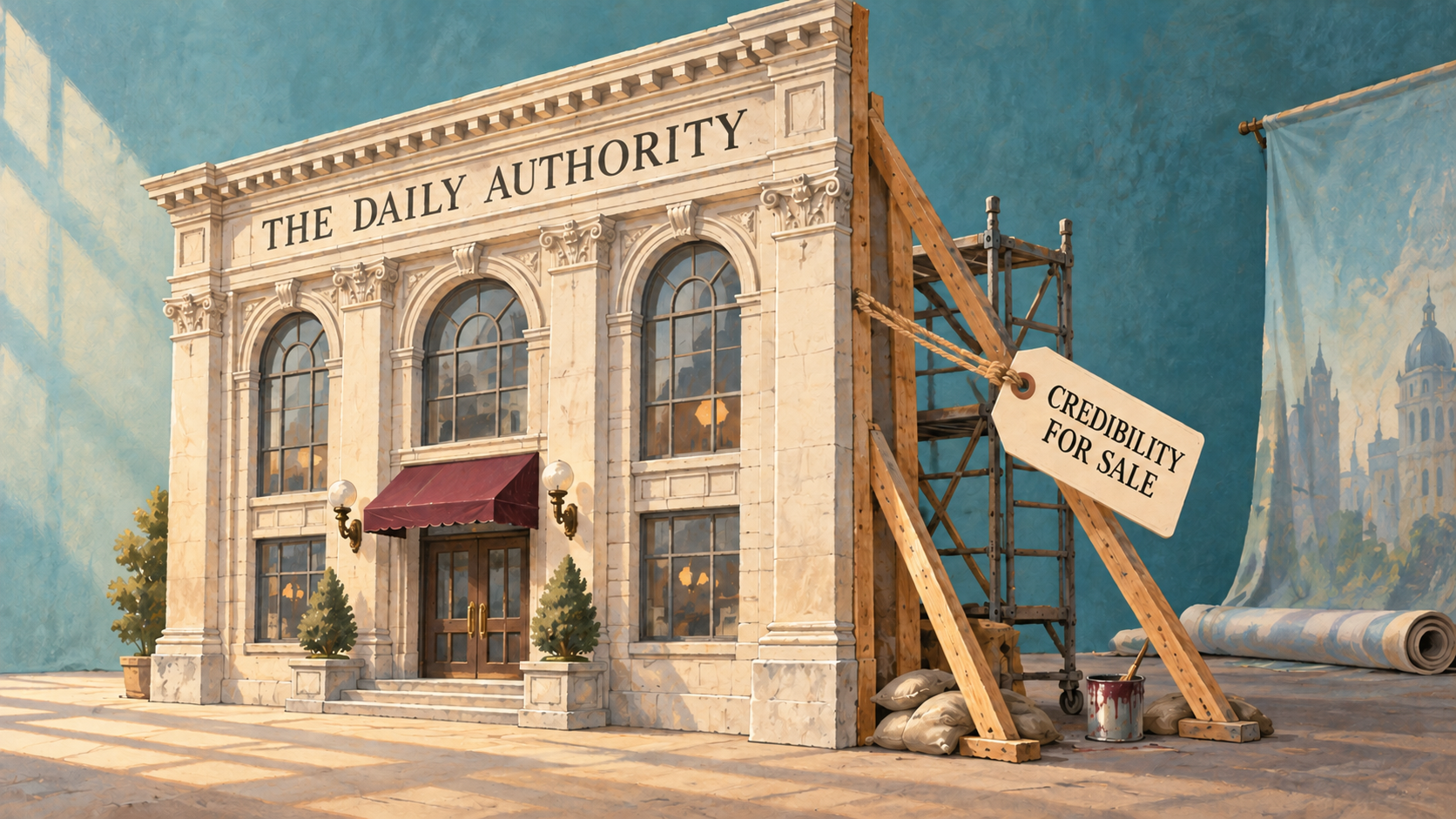
The question now is whether the publication doing the writing was ever real.
Press Gazette published something last month that caught my eye. A reporter took a closer look at a set of websites that look like Forbes: Forbesla.com and Forbesliechtenstein.com. He discovered they weren't Forbes or related to the highly-regarded news site at all.
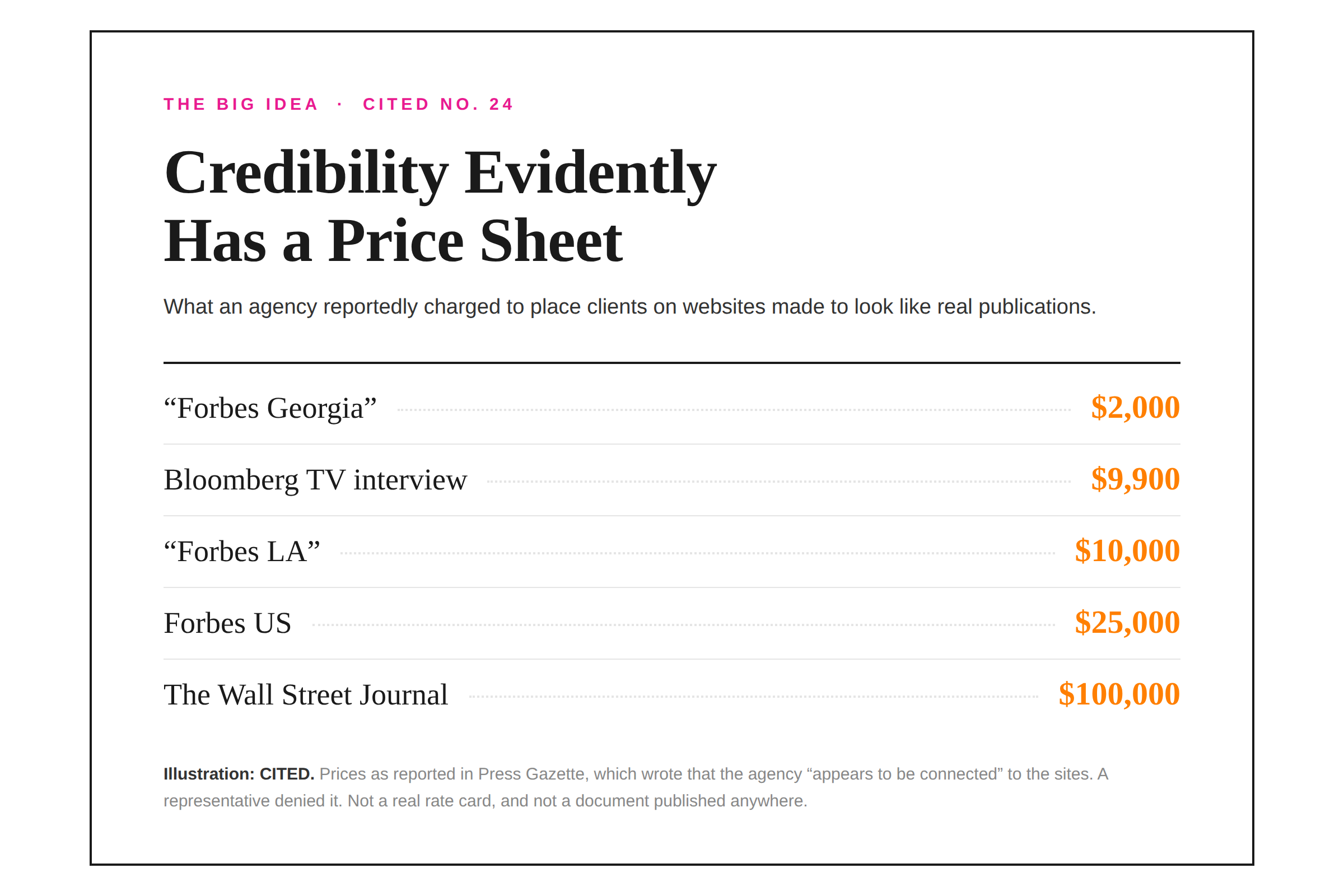
According to Press Gazette, a PR agency called Baden Bower appears to be connected to the sites, and its representatives offered guaranteed coverage at set prices. Forbes Georgia, $2,000. Forbes LA, $10,000. Forbes US, $25,000. A Bloomberg TV interview, $9,900. The Wall Street Journal could be snagged for the mere price tag of $100,000. One representative later sent follow-up emails denying it and pointing to legitimate licensed Forbes editions.
So the agency offered a menu that ranked mastheads on how much domain authority each one carries.
Here's what makes this pay-to-play different from other ones. Pay-to-play bylines published in a real publication aren't anything new. The problem with what this particular agency was hawking was that the news sites were completely fake. Somebody built the masthead, filled it with AI-generated copy, made it look legit, and sold the impression of having been covered in Forbes, Bloomberg and The Wall Street Journal.
We argued back in April that AI engines catch fakers because they triangulate across independent sources. That defense rests on one assumption which is that independent sources are hard to manufacture. In this example, the agency wanted to cut corners and deliberately decided that it's cheaper to build an independent source than to earn one.
Meanwhile, the tech industry's answer to synthetic content (a.k.a. fake content) is watermarking. Anthropic started marking Claude's output in August. The EU AI Act started requiring marks the same month. All of it answers one question: was a machine involved in producing this text?
We believe that's the wrong question. A fake Forbes site that a human designed and wrote from start to finish is just as fraudulent. The fraud is the masthead, not the content. What matters is whether Forbes actually published the articles, and a watermark can't answer that.
We're marking an AI's output when the thing that needs marking is really the publisher's stamp. That technology already exists. Cryptographic signing at publication, verifiable back to the source. It also moves the work to the right place. Today the burden falls on everyone downstream, the reader, the client, the engine, all squinting at fakes that cost almost nothing to produce. Take one down and another appears. Very much like the Whac-A-Mole game. Signing moves that burden onto the publisher instead, one time, at publication. Detection has to catch every fake. Provenance only has to prove the real one is real.
Which turns into a question your clients will start asking, sooner than you think. Not "did we get coverage." Can you prove this citation is real?
Source: Press Gazette.
Get Found. Get Cited. Get Chosen.