AI engines forget your brand in 37 days. Here's why.
Why brand work has shifted from campaigns to a continuous practice
Imagine this scenario: a buyer asks ChatGPT for the top five vendors in your category. And lo and behold, your brand is missing from the answer! The product is strong, the messaging is sharp, the team is doing real work. So what happened? It's quite possible that the last piece of content with your name on it shipped in February, and the AI engine has already moved on.
Until recently, the marketing playbook for this problem was a big quarterly campaign. Plan it carefully, time the launch, coordinate the social, the press push, the gated content, the newsletter, ads, and landing page. Measure for thirty days, then close the books, rinse and repeat, and start planning for the next quarter. The old discovery mechanism used to reward that rhythm.
AI engines don't reward the old discovery mechanism and rhythm the same way.
Josh Blyskal, a founding team member of Profound, just published the first real benchmarks on how fast AI engines actually cite content. The report covers billions of citation logs and roughly 900 freshly published marketing pages. The median time-to-first-citation in ChatGPT and Claude is 6.81 days, 75% of pages get cited within 18.68 days, and 90% within 37 days. After day 37 without a citation, the bottleneck becomes technical: schema markup gaps, indexing rules, page architecture, or sitemap entries that block AI engine crawlers. Waiting longer will not fix it.
In May, Muck Rack's Generative Pulse Study added a second layer to this picture. Of every URL surfaced inside ChatGPT and Perplexity answers, 57% were published within the last 12 months. Older content showed up at roughly one-third the rate compared to newer content.
Take the two findings together and a pattern locks into place. AI engines weight authority and recency in the same answer. A page can have all the authority signals in the world, the right domain, the right backlinks, the right schema, and still drop out of the citation answer set if it hasn't been refreshed inside the citation window.
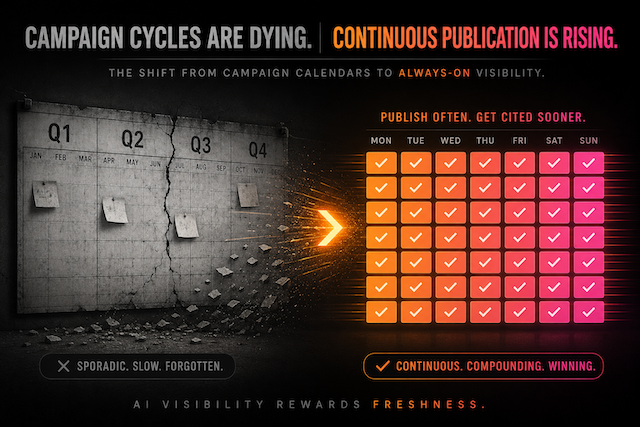
At Ignite X, we are calling this The 30-Day Rule. AI-era brand work has shifted from campaign cycles to continuous publication. The brands that win the AI citation graph in 2026 and 2027 will be the ones treating earned media as a recurring discipline, with quality, cadence, and freshness now traveling in lockstep. AI engines need all three qualities before they issue a citation with confidence.
Cadence and volume are different disciplines. AI engines reward quality content that stays fresh inside the citation window, and they penalize generic, high-volume publishing on owned channels (i.e., the company blog). According to Profound's study, only 4.3% of B2B citations come from owned content. The 30-Day Rule applies to the high-quality pieces you already produce. The discipline is keeping them fresh, refreshing them on a 30-day rhythm, and making sure every new piece earns its place in the citation graph.
The contrast plays out cleanly in any category. Consider two competitors selling the same product. Brand A publishes a Q1 launch campaign, takes the summer off, returns with a Q3 push. Brand B ships one high-quality content piece per week, refreshes its pillar pages every 30 days, and learns from each piece to sharpen the next. Six months in, both have produced similar total content volume. Yet every time a buyer asks an AI engine for a recommendation in their category, Brand B surfaces. Brand A's content was excellent in February. The citation window, however, closed before the buyer ever opened a chat.
Here is what The 30-Day Rule looks like in practice. The teams winning AI visibility ship one high-quality piece per week, refresh their pillar content every 30 days, and treat the newsroom and content calendar as one connected system. Every piece is timestamped, schema-marked, and built to be picked up inside the next citation cycle.
The implication for marketing leaders is a real rewiring. Budgets shift toward continuous production, editorial teams operate on 30-day cycles, and performance dashboards now track citation share and freshness alongside the traditional impression and reach numbers.
This is what makes Gartner's 2x earned media budget prediction look conservative. Continuous publication takes more sustained effort than a quarterly campaign. The budget that funds it has to be structured for sustained operation. The brands ahead of this shift are already restructuring their PR and marketing line items to reflect it.
At Ignite X, we think about this as a rhythm question on top of a quality question. AI engines reward freshness, signal density, and consistent presence applied to content that already earns its citation. Volume on its own moves nothing.
If you're still planning Q3 like it is Q3, you've already missed the citation train. The next citation cycle is closing while you read this, and the one after opens just as fast. Plan accordingly!
Get Found. Get Cited. Get Chosen.
Sources: Gartner communications predictions.