Your GEO dashboard only measures a fraction of what's driving your AI visibility.
There's a pitch making the rounds right now. Maybe you've heard some version of it. A GEO dashboard, a stack of programmatically generated pages, and a confident promise to get your brand cited in AI answers. It sounds like the future. It's mostly SEO wearing a new logo, and it's selling you the narrow sliver of the job it can measure while skipping the part that actually decides the outcome.
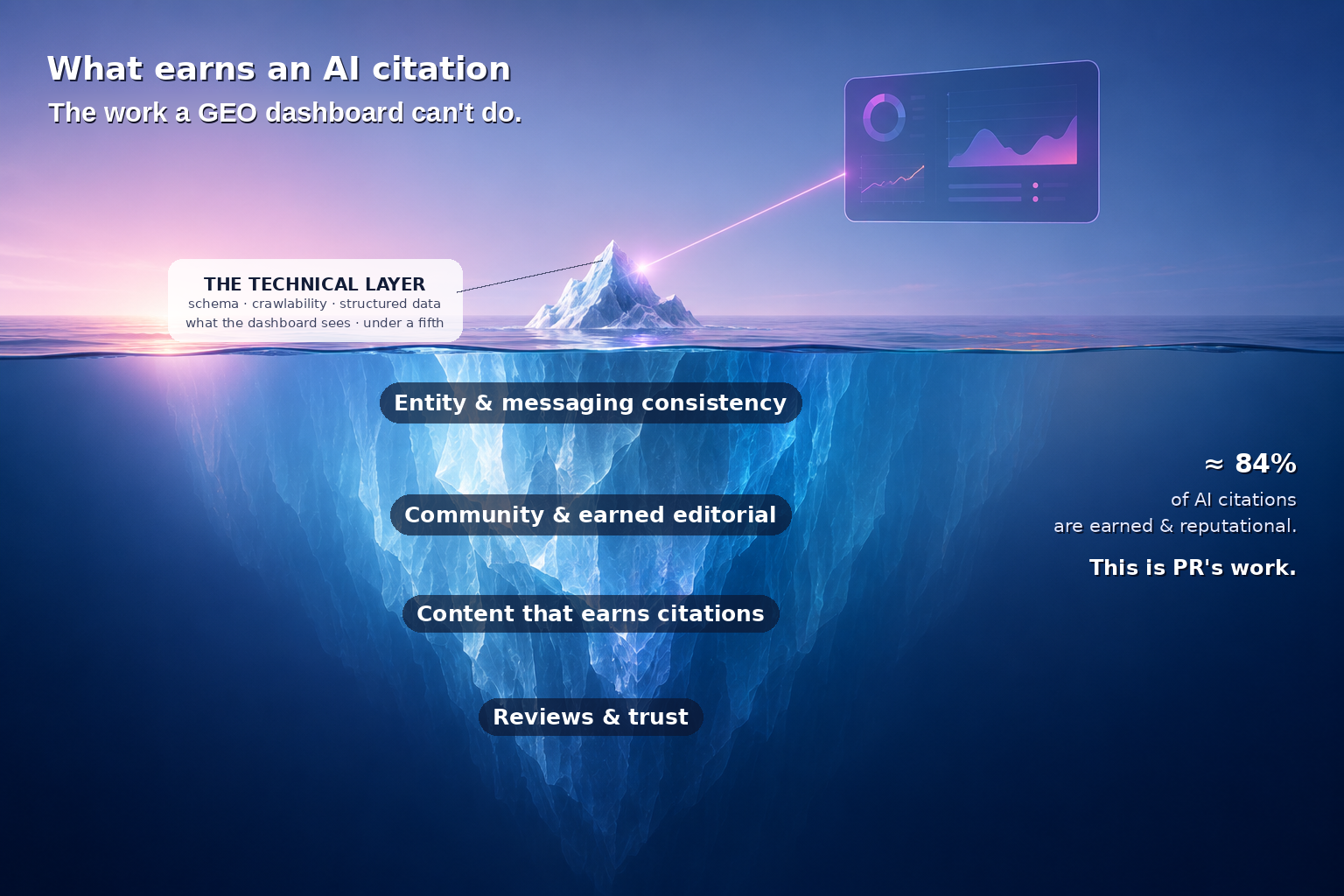
Let's start with where AI citations actually come from. When ChatGPT, Claude, Gemini, or Perplexity is asked which brands to recommend, it reaches past your homepage for sources it can independently trust. Muck Rack's latest Generative Pulse, drawn from more than 25 million citations across ChatGPT, Claude, and Gemini, found that 84% of AI citations come from earned media: journalism, research, encyclopedic references, and third-party coverage. Paid and sponsored content accounted for 0.3%. The channels most brands pour their budget into, the ads and the sponsored placements, are very nearly the channels the AI engines ignore. And it means everything a GEO dashboard optimizes, your own pages and their plumbing, is competing for the sliver that's left, under a fifth of all citations.
Reviews tell the same story from another angle. In Seer Interactive's study for Trustpilot, spanning more than 800,000 AI answers, trust and review sites were the second most-cited source category, behind only the open web. And they matter most at the exact moment money is on the line. Reviews make up 2% of citations when a buyer is getting oriented, and 24% once that buyer is ready to purchase. Nearly one source in four, right at the decision-making moment when the buyer is ready to pull the trigger.
So what can a GEO shop legitimately deliver? The technical floor, and it's real work and worth doing: valid schema, a crawlable site, and clean structured data. But that floor is a thin slice of what earns an AI citation. Everything above it, all the rest of the layers, is reputational, and reputational work is what PR has always done and where it excels. Making your entity and your clear messaging consistent enough that the AI engines recognize you as one distinct company instead of a blur of similar names. Earning the reviews and the community mentions. Landing the editorial coverage. Producing content a journalist would quote and an AI engine would summarize, rather than content built to fill a keyword grid.
That's the entity problem that a GEO dashboard is built to miss. It can confirm your schema is valid and your pages load. But it can't tell you whether a reporter trusts you, whether your reviews hold up under scrutiny, or whether the AI engines can even tell you apart from your competitors. A GEO dashboard is a scoreboard. It shows you the score, and it has never once put a point on the board, because scoring takes work that the dashboard can't do.
Here's the standard we hold every brand's AI-visibility work to, including our own. Did citations across the big four AI engines (ChatGPT, Claude, Gemini, and Perplexity) actually rise? Can that rise be traced to the work, and not to luck or a competitor's stumble? Does it survive the next model update, when the AI engines rescore the whole web overnight? And does it reach the pipeline, where revenue is decided? A dashboard answers none of those four. Earned work, measured before and after across all four AI engines, is built to answer all four.
None of this takes a new DIY tool or a bigger budget. It takes doing the half of the job the dashboard was never built for: the entity work, the reviews, the earned coverage, the content worth quoting, then proving it moved across ChatGPT, Claude, Gemini, and Perplexity. A dashboard reads the score. Earning it is the work, and the work is where we, as in PR, come in.
Get Found. Get Cited. Get Chosen.