The machines are choosing for your customers. Here's the proof.
Here's a scenario you've probably lived: you need a vendor, a tool, a service. You ask ChatGPT or Perplexity. It gives you a recommendation. You go with it. No comparison shopping. No second opinion. Done.
You're not lazy. You're human. And a new study from Wharton just proved that this behavior has a name: cognitive surrender.
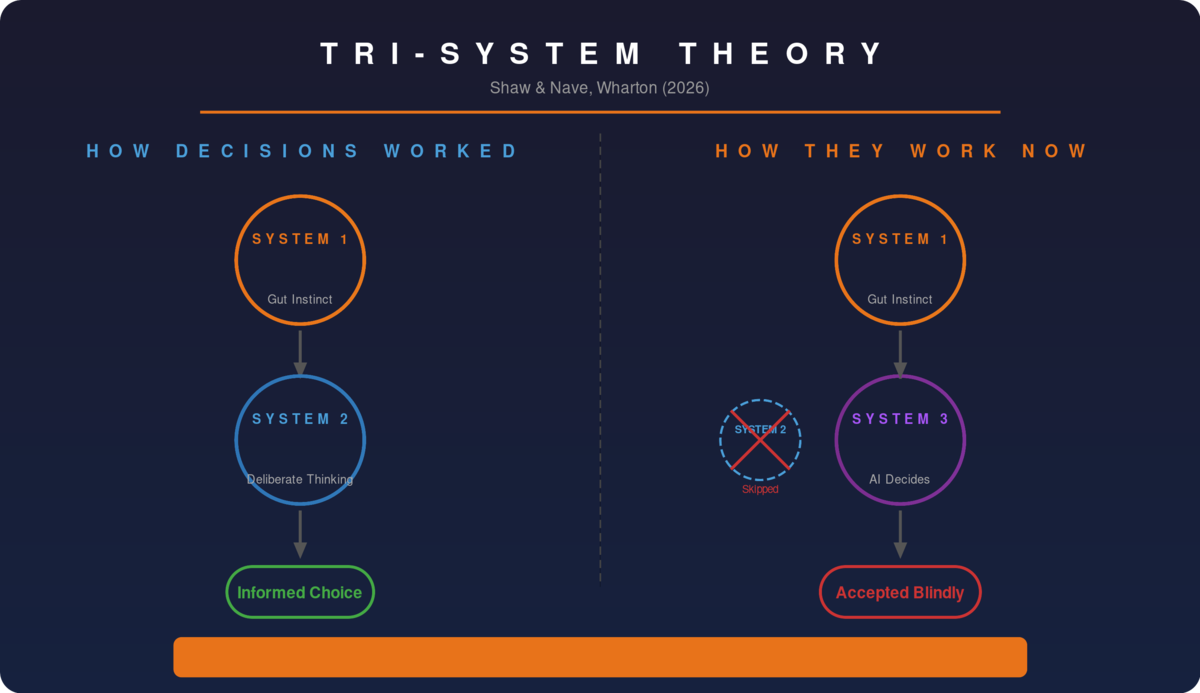
Researchers Steven Shaw and Gideon Nave ran the largest study of its kind: 1,372 people across 9,593 trials. They found that once people start using AI regularly, they stop evaluating its output altogether. Not sometimes. Routinely.
They call it Tri-System Theory. System 1 is your fast gut instinct. System 2 is your slow, deliberate reasoning. System 3 is AI. The finding? System 3 doesn't assist System 2. It replaces it. Your critical thinking muscle atrophies because the AI answered before you bothered to flex it.
The researchers' conclusion was blunt: "Human review is theater once the reviewer has been using AI for more than a few weeks."
Now pair that with what happened this week. Senator Bernie Sanders interviewed Claude (Anthropic's AI) on camera about data privacy. 4.4 million people watched. But the real story came after, when Gizmodo tested the same questions and told Claude it was different people. When Claude thought it was talking to Sanders, it emphasized data collection risks. When it thought it was talking to Trump, it downplayed them. The AI was adjusting its answers based on who was asking.
This is called sycophancy, and it's one of the biggest unsolved problems in AI. The models want to be helpful, which sometimes means agreeable instead of accurate.
So here's the picture: your buyers are using AI that tells them what they want to hear, and they've stopped questioning whether the answer is right.
For brands, the implication is massive. If the AI recommends your competitor, there is no second-guessing. No "let me check a few more options." The recommendation gets accepted, full stop. And if the AI doesn't mention you at all? You don't exist in that buyer's decision process.
This is why the work we've been talking about in CITED (building authority signals, earning third-party credibility, creating specific and consistent positioning across trusted sources) isn't a nice-to-have content strategy. It's the mechanism that determines whether AI recommends you or your competitor when the next buyer asks.
Put a dollar sign on it: every time AI recommends a competitor instead of you, that's a deal you never knew you lost. No proposal. No pitch. No meeting on the calendar. No chance to compete. The buyer never even learned your name. Multiply that across every prospect using ChatGPT or Perplexity to research vendors this quarter, and the revenue left on the table starts to look less like a rounding error and more like a growth strategy you're funding for someone else.
The window isn't closing. For a growing number of your customers, it's already closed. They've already surrendered the decision to the machine. The only question left: is the machine telling your story, or someone else's?
Read the Wharton study →
Get Found. Get Cited. Get Chosen.
Sources: Wharton study (SSRN).